

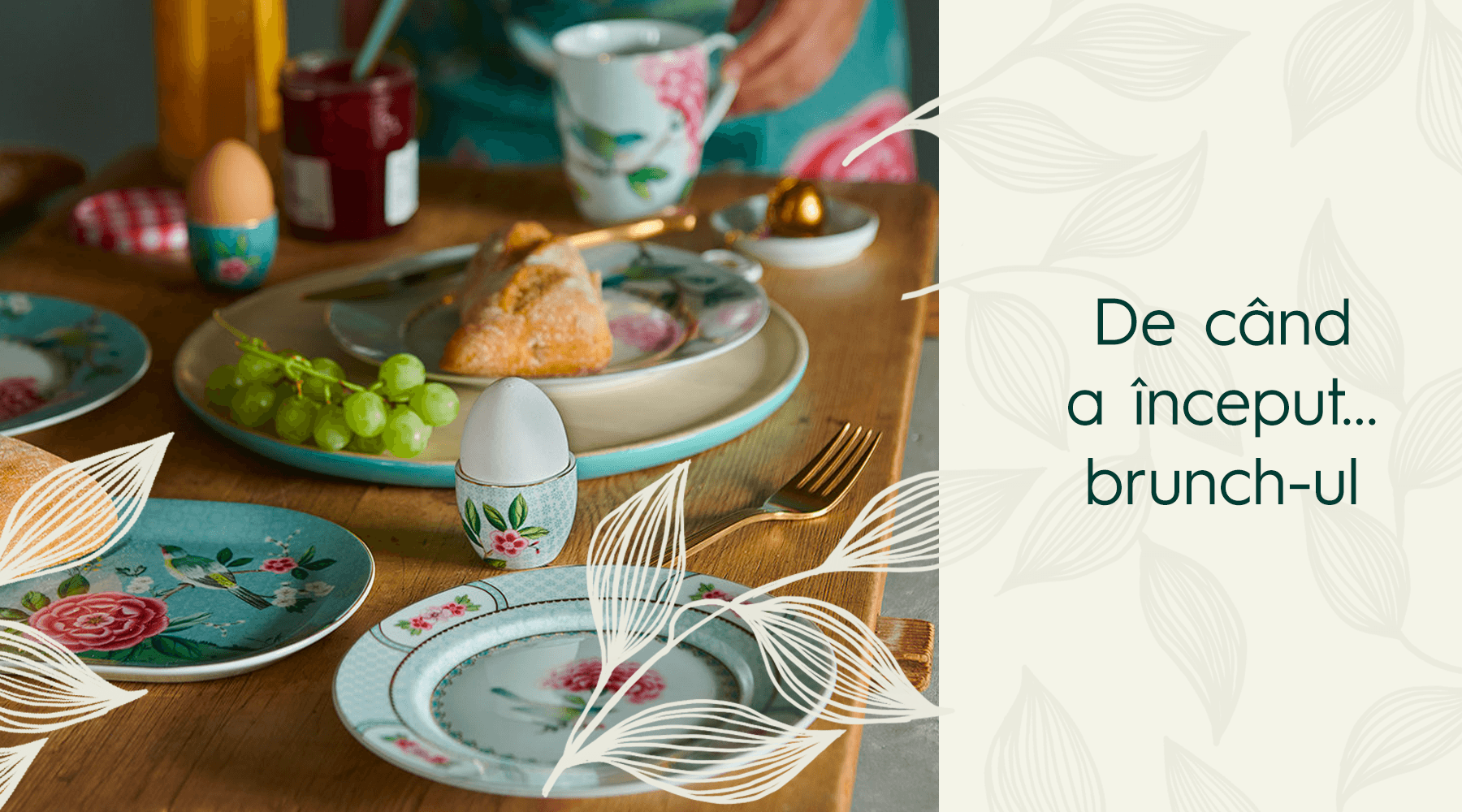
The term “brunch” is of Anglo-Saxon origin, having been recorded in a dictionary after 1890. It is formed by contracting the words ”breakfast” and ”lunch”. This type of meal was invented in England by noble and bourgeois families, where on weekends the whole family waited for the gentlemen to return from hunting to sit down to eat.
In the USA, this type of meal appeared at the end of the 19th century among wealthy families, with the meal being eaten after returning from religious service. Brunch replaces the two aforementioned meals and is generally practiced between 11 AM and 3 PM or 3:30 PM. Sweet dishes, more readily associated with breakfast, are combined with savory ones, according to preference, without a precise order. Being generally a convivial and informal meal, brunch is organized with family and/or friends in the late morning and early afternoon. It usually takes place on Saturday or Sunday. We organize a brunch when we want to spend almost the entire day with loved ones, without being constrained by certain rules. The invitation is made simply by phone, and everyone can come to the table during these hours.
In France, brunch only began to be widely known and successful in the early 1980s, when in large cities, going out to a restaurant on Sunday started to become almost mandatory. In Romania, the same phenomenon occurred around 1995, when going out for Sunday Brunch with friends at large restaurants became fashionable.
About
A brunch is organized buffet-style, with everyone serving themselves. In the preparation of the buffet, we find components of both breakfast and lunch. Drinks such as tea, coffee, chocolate, fruit juices, etc. can be served. More or less substantial foods such as cereals, omelets, yogurts, eggs in various forms, sausages, fried bacon, ham, hard cheese – cheddar, Emmental, Swiss cheese, etc. We also serve fish or cold cuts, tarts, dry cakes, pound cake, rice pudding, etc. There is no well-defined rule. Of course, at home, everyone organizes the buffet according to their inspiration and possibilities. The important thing is that all participants can serve themselves, taking into account their preferences.
If you want to create a sophisticated brunch, you can add: smoked fish, red or black caviar, herring, various types of ham, salads – pasta, rice, cabbage, tomato, etc. and drinks such as: champagne, prosecco, cocktails, etc. In fact, cocktails like Bloody Mary, Bellini, Mimosa or Milk Shake were invented during Prohibition and at brunches. Also during Prohibition, between the two world wars, brunch began to spread among the American middle classes. When women started to get jobs, it was considered faster, more economical, and more practical to prepare only one meal on Sunday.
In France, where gastronomic culture is deeply rooted, preparing food is not considered a waste of time or a chore. French families go to the market together, return, and prepare Sunday lunch together. Here, the term "dejeuner-buffet" is often used instead of the English term: brunch.
Of course, at a brunch, you can also serve cooked food, but the idea remains that everyone serves themselves, and the host can enjoy everyone's presence by staying at the table with the guests as long as possible.
Starting in the 1990s, in both France and America, this concept was adopted with great success, first by restaurants in trendy neighborhoods, and then by larger restaurants. In one of the restaurant's halls, a more or less elaborate buffet is organized, with more or less balanced food and a fixed price, where everyone serves themselves what they want. Depending on the restaurant, alcoholic beverages may or may not be included in the price.
Brunch has become a relaxing, convivial moment, ideal for an informal gathering with friends or family, at home or at a restaurant. Brunch is different at home than at large restaurants.



Share:
Glasses and a bit of history
History of scales