

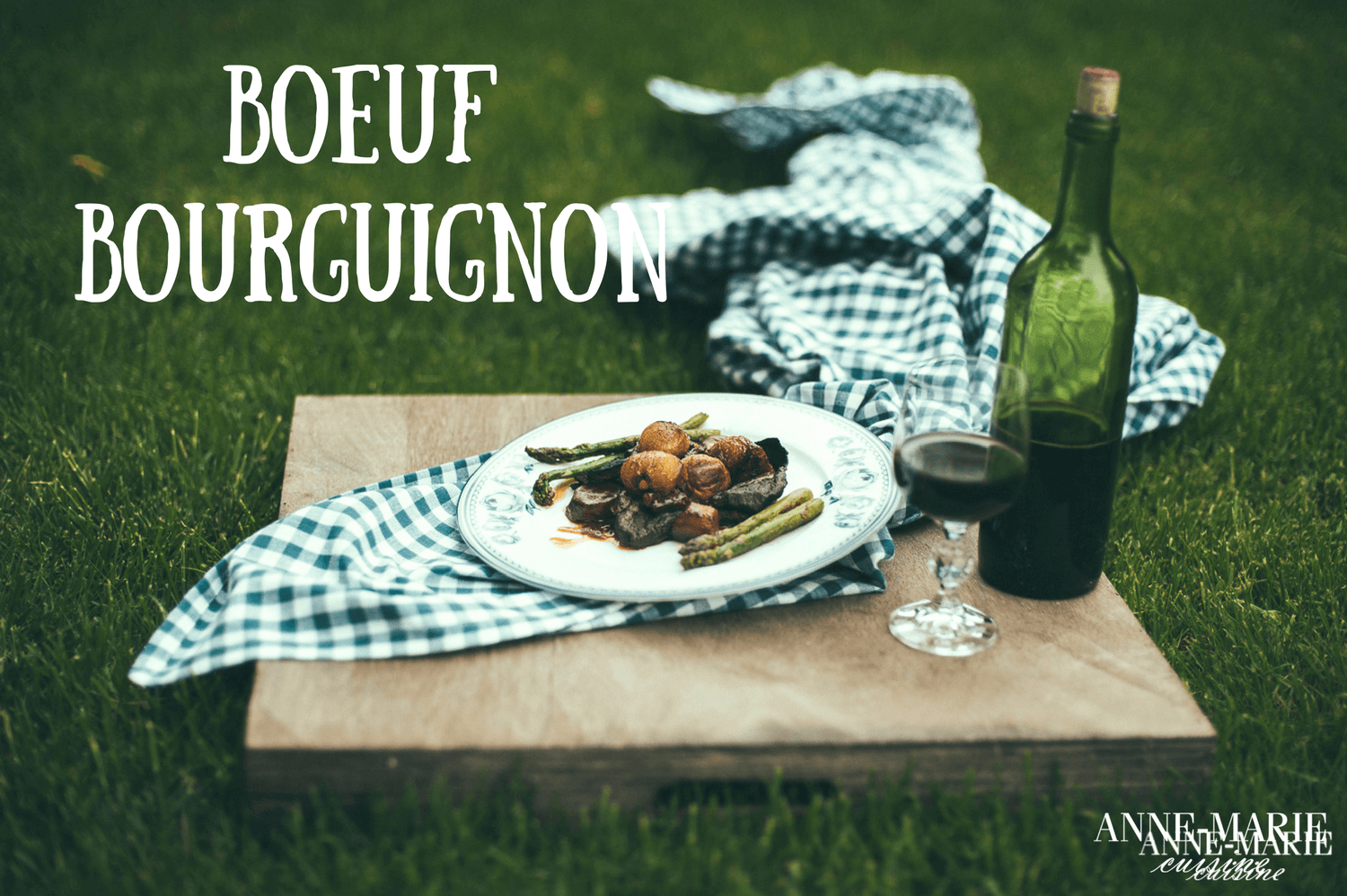
Boeuf Bourguignon
Intro
For many generations, peasants, fishermen, housewives, and aristocrats, not to mention French chefs, have lovingly and meticulously created one of the most superior arts in the world - the culinary art. Today we will cook Boeuf Bourguignon, a pastoral recipe that was perfected over time by the French chef August Escoffer.
Ingredients
(for 6 servings)
- 180g bacon
- 1 tablespoon olive oil
- 1.2 kg beef fillet
- 1 chopped carrot
- 1 chopped onion
- 1 teaspoon salt
- 1/4 teaspoon pepper
- 2 tablespoons flour
- 3 cups young red wine
- 2-3 cups beef broth (page 131)
- 1 tablespoon tomato paste
- 2 cloves garlic
- 1/2 thyme
- 1 bay leaf
- blanched bacon rind
- 18-24 glazed onions
- 450g mushrooms sautéed in butter
Preparation Method
- Cut off the bacon rind and cut it into 4 cm strips. Boil the bacon in 1.5 L of water for 10 minutes. Drain the water and dry the bacon.
- Preheat oven to 230 C.
- Brown the bacon in one tablespoon of oil and set it aside to dry. Place the pan back on the heat until the fat starts to smoke slightly.
- Dry the meat with paper towels; if the meat is wet, it will not brown. Sear the fillet on all sides and add it to the bacon.
- Brown the chopped vegetables in this fat and drain it.
- Add the flour, salt, and pepper, shake the container to mix the ingredients evenly. Place in the middle of the oven for 4 minutes, then remove the container from the oven and shake again, then return to the oven for another 4 minutes. This way, the butter will brown and coat the beef, which has formed a crust. Remove the pan and lower the oven temperature to 160 C.
- Add the wine and enough broth to cover the meat, add the tomato paste, garlic, herbs, and bacon. Bring to a boil on the stovetop, cover with a lid, place the pot in the lower part of the oven and adjust the temperature until it simmers gently, leave for 3-4 hours.
- Meanwhile, cut the mushroom caps, butter them, and grill them or pan-fry them for 4 minutes on one side and 4 on the other, until tender.
- Prepare the onions according to this recipe.
- When you take the beef out of the oven, add the vegetables. Serve as follows: the first layer should be the beef, and the second - the vegetables.
Glazed Onions in Dark Glaze
Oignons Glaces a Brun
Onions prepared "a brun" are used for brown-colored dishes, such as chicken with red wine, onions, and bacon.
Ingredients
- 18-23 small onions
- 1 1/2 tablespoons butter
- 1 1/2 vegetable oil
- 1/2 cup beef broth
- salt and pepper
- bouquet garni (4 parsley sprigs, 1/2 bay leaf, 1 tablespoon thyme) tied in string
Preparation Method
- Pour the oil and butter into a pan, heat it, and add the onions until they are maximally and uniformly browned, at the same time being careful not to destroy their texture.
- Add the broth, salt, pepper, and bouquet garni, cover with a lid, and simmer until the liquid evaporates. When everything is ready, remove the bouquet garni.
Beef Broth
- 3L meat and bones
- 2 teaspoons salt
- 2 peeled carrots
- 2 celery stalks
- bouquet garni
History
Legend has it that French cuisine was born in the Middle Ages when King Henri II of France married Catherine de' Medici, the daughter of Italian nobles. It is said that the future queen of France brought with her to the royal court the best Italian chefs and pastry chefs to help her organize the menus for the extravagant parties, which had become a royal custom.
Even if this legend is not very popular among the French for easily understandable reasons, whether or not it has a grain of truth, one thing is certain: French cuisine is currently a global gastronomic leader. It is officially recognized for its contribution, so in November 2010, UNESCO included French cuisine in the world cultural heritage.
End
Traditionally, this dish is served with boiled potatoes. It can be replaced with steamed rice or, if you prefer vegetables, choose green peas or asparagus sautéed in butter. Serve the Bourguignon stew with a young and full-bodied red wine.



Share:
Charlotte Malakoff
Spicy pumpkin soup with dark chocolate