

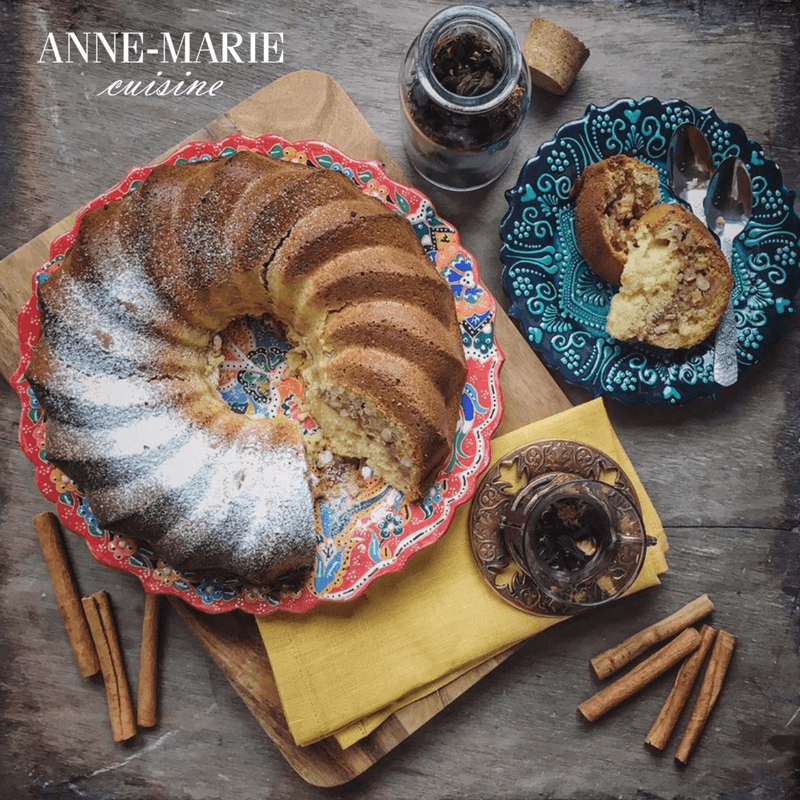
There are recipes that we cook out of necessity, but some are destined to take us on journeys around the world.
I believe that autumn and winter are synonymous with cooking, family atmosphere and (pleasant, of course) nostalgia - summer never has time because everyone enjoys the sun and evenings when you can show off your fresh outfit and perfume.
Gugelhupf is a recipe with an important connotation worth considering - in 2006 it was chosen to represent Austria at the European Café.
This cake is traditional in Switzerland, Germany, and Austria, has different interpretations but most importantly, it resembles the "Keksurile" (cookies) from our childhood that our mothers used to make in aluminum molds.
The origin of the word guguluf is the German word Gugelhupf or Gugelhopf, where Gugel means "cowl", "hood", fashionable in the Middle Ages in Germany, and Hupf (Hefe) means "yeast (baker's)". Some believe that the German name Gugelhupf comes from the German word Kugelhut, where Kugel means "ball", "lump", and Hut means "hat".

The classic shape found in the Unterlinden Museum in Colmar, France.
Its characteristic is the height of the cake - unfortunately I didn't have such a tall mold, but I also didn't want to give up on the recipe.
Easily cuts 12 slices
Ingredients for the filling:
- 75 g flour
- 30 g soft butter
- 1 teaspoon ground cinnamon
- 150 g chopped pecans or other nuts
- 125 ml maple syrup or whatever you have
Ingredients for the cake:
- 300 g flour
- 1 teaspoon baking powder
- 1 teaspoon baking soda
- 125 g soft butter
- 150 g granulated sugar
- 2 eggs
- 250 ml heavy cream or whipped cream
- 1-2 tablespoons powder for decoration
- 1 loaf pan 23 cm
Preparation method:
- Preheat oven to 180 C. Grease the pan with butter.
- Prepare the cake filling by mixing 75 g of flour with 30 g of butter with a fork until you get a crumbly mixture.
- Then, still with a fork, add the cinnamon, chopped nuts, and syrup to the mixture to obtain a thick paste. Set aside for a moment.
- For the cake, mix the flour, baking powder, and baking soda.
- Cream the butter with the sugar until you get a light and pale texture, then incorporate a tablespoon of the flour mixture, then an egg, then another tablespoon of the flour mixture, followed by the second egg.
- Add the rest of the flour, continuing to mix, and finally, incorporate the sour cream. You should obtain a firm dough.
- Spoon a little more than half of the dough into the greased pan. Lift the dough along the edge of the pan, all around and around the small tube in the middle, to form a trench. The thick filling must not spill over the edge of the pan.
- Carefully spoon the nut filling into the trench formed by the dough, then cover with the remaining dough. Level the surface and bake for 40 minutes. You should check the cake with a toothpick after 30 minutes.
- After removing the cake, let it cool in the pan for about 15 minutes on a wire rack. Then loosen the edge with a spatula, including the edge around the middle tube, and invert the cake onto a serving plate.
- Dust the cooled cake with sugar.
Bon Appetit!




Share:
Spicy pumpkin soup with dark chocolate
Chicken Tikka Masala