
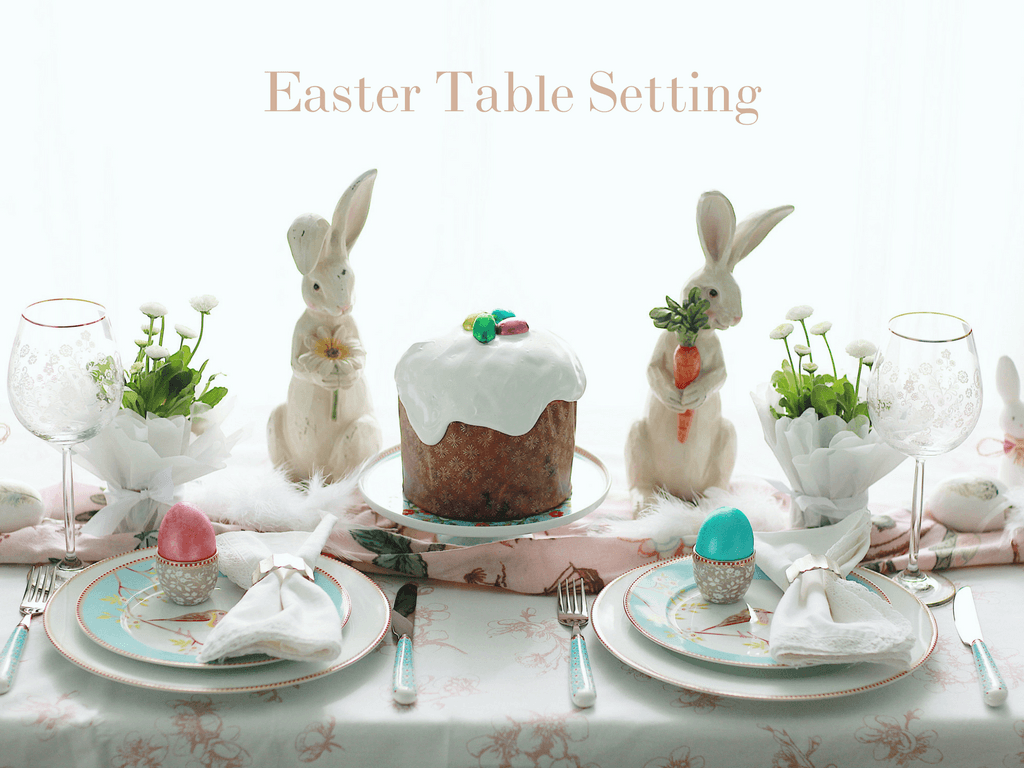
Today we want to tell you a bit about our Easter table, specifically what we used for it and how we decorated it.
We often wonder how relevant the notion of a "perfect table" is, since perfection is such a subjective term, and yet, setting the table, in our opinion, is a creative process in which we manifest a kind of artistry. Perhaps sometimes, to feel freer in creation, it's good to exclude the word "perfect" from our vocabulary and let intuition guide us.
Of course, there are a few rules that help us organize our decor, let's list them!
1. Colors are a key element in any arrangement. Design classics say that our eyes like it when no more than 3 colors are combined, among which black and white are considered non-colors. We used azure blue and combined it with a peach pink; we also have brownish elements that complement those mentioned above.
2. The tablecloth is an indispensable element if we consider serving etiquette. The same category includes napkins, which can be used by guests to protect their laps. We also used a runner, which we ruffled to give our table a light, airy feel.
3. The centerpiece is the main accent of the table. Here you can unleash your imagination because the moment of creation has arrived. Since our table was rectangular, we opted for symmetry and decorated only the runner's space. For this, we used natural elements such as potted flowers; you can use wheatgrass or tulips, which will give your table a seasonal feel. Bunnies are a classic element in Easter decor; they are usually egg-bringers. In European culture, they bring sweets only to children who have behaved well. You can also use decorative lambs and embossed eggs; we used porcelain eggs, feathers, chocolate eggs, and fabric and ceramic bunnies.
4. Paska, cozonac, and eggs are a distinctive element of the Easter table, especially in our culture. The smell of cozonac is that cliché that takes us back to childhood. Be original and turn the eggs and cozonac into the king and queen of the Easter table, arrange the eggs in special holders and serve the cozonac as a special dessert.
5. The plate decor gives us an opportunity to greet guests or even family members beautifully. We used egg holders, which is the simplest decorating method. More sophisticated would be to write the guest's name on a small card and place a small gift on the plate, such as a decorative or chocolate bunny, or perhaps even a chocolate egg.
6. Plates are indispensable. The French, for example, usually have 4 sets at home: a basic one, a festive one (regardless of the season), one for Christmas, and one for Easter. And to get back to the subject, it's ideal to have neutral plates if you don't have a set with spring decor. You also need to consider the color of the plates when referring to the 3 basic colors. The plate on top has a diameter of 21 cm; it is used first for appetizers. When the main course (in our culture, "the hot meal") is served, the 27 cm main plate comes into action. We can reuse the 21 cm plate for dessert (if you don't have 17 cm plates) at the end of the festive meal, and where there's a tasty dessert, there's always tea.
Don't forget that decor creates an unforgettable atmosphere at any celebration. Experiment and don't hesitate to share photos of your Easter table with us.
To beautifully arrange your festive table, Eclair comes to your aid with a wide selection of products (click here), and with some examples we have specially prepared for you:


We wish you a Happy Easter!


Share:
10 Gift Ideas for International Women's Day
The Culture of the Picnic in the Romantic Era